Alloy wheels
Alloy Wheel Colour Change: Costs, Options and Process
How an alloy wheel colour change works, which finishes last longest, what it costs, how long the wheels are off the car and what it means at lease return.
10 minute read By Signature Alloy Wheel & Body Repairs
In short
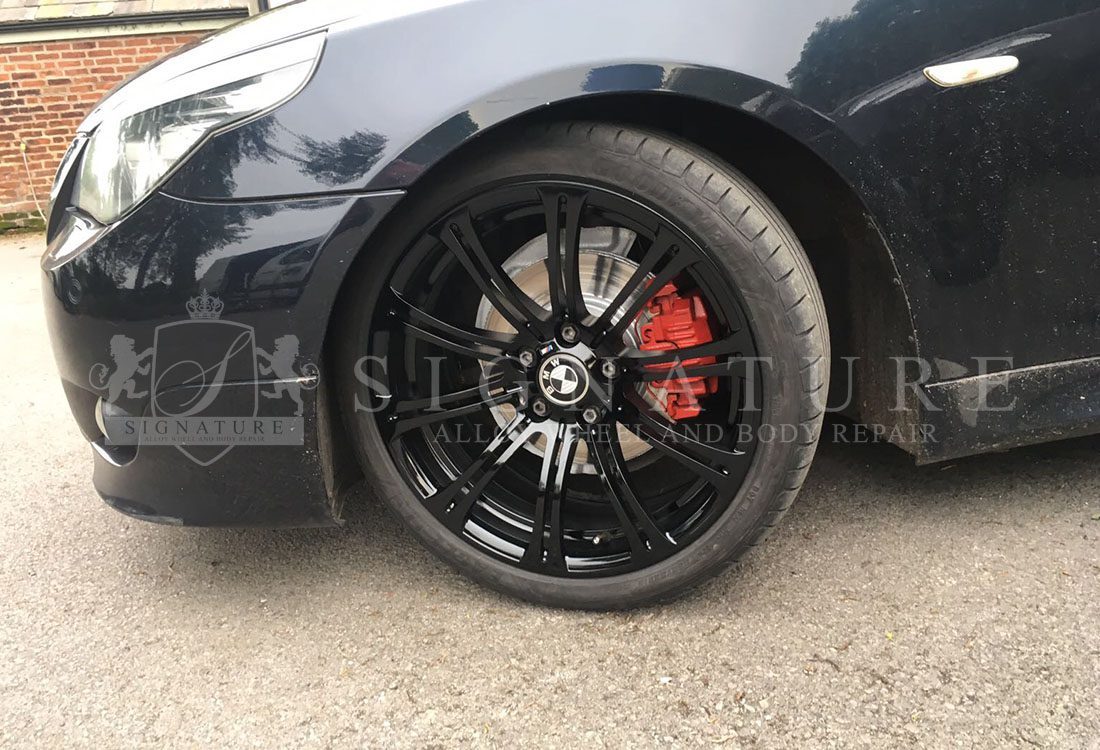
An alloy wheel colour change means stripping the existing finish, repairing any kerb damage and refinishing the wheel in a new colour, usually by powder coating or wet spray. Wheels come off the car and tyres are normally removed. Expect the car to be off the road for one to three days depending on finish.
Changing the colour of a set of alloys is the cheapest way to visibly change a car, and because the wheels are coming off anyway it is usually done at the same time as repairing kerb damage. The decision that matters most is not the colour, it is the finish process, because that determines how the wheels look in three winters' time.
What is an alloy wheel colour change?
It is a full refinish: the existing paint or lacquer is stripped back to bare aluminium, kerb damage and corrosion are repaired, and the wheel is coated in a new colour and sealed with lacquer.
It is not a wrap, a dip or a coat of aerosol over the old finish. Those exist and have their place, but they are surface treatments rather than a refinish, and they behave completely differently once brake heat and wheel cleaner get to work on them.
The important consequence is that a colour change and an alloy wheel refurbishment are the same job. If your wheels are already kerbed, corroded or lacquer peeled, the colour change costs no more in labour than putting them back to standard. You are paying for the strip, the repair and the refinish either way.
How much does an alloy wheel colour change cost?
Cost is quoted per wheel and driven by four things: diameter, existing condition, the finish you choose, and whether the wheel construction is straightforward.
What pushes a quote up:
- Diameter. A 20 inch wheel takes more material and more preparation time than a 16 inch one.
- Damage. Deep kerb gouges, cracked rims and corrosion under the old lacquer all need welding, filling and rebuilding before any colour goes near them.
- Finish complexity. Solid gloss and satin colours are the most economical. Metallics, candy finishes, pearls and two tone treatments need more coats and more skill.
- Construction. Split rims and multi piece wheels have to be separated, refinished and rebuilt with new bolts and sealant. Wheels with intricate spoke designs or exposed lug pockets take much longer to prepare.
- Extras. Centre caps, valve caps and calipers are usually priced separately if you want them done to match.
Quotes given over the phone are estimates. A set of wheels that looks tidy from two metres away often reveals corrosion under the lacquer once stripping starts, so expect a proper quote to follow an inspection.
Powder coating, wet spray or a machined face: which finish?
Powder coating is the most durable option for a colour change and is what most refinishers use as standard. Wet spray gives more colour flexibility, and a diamond cut face is a different process altogether.
| Finish | How it works | Durability | Best for |
|---|---|---|---|
| Powder coating | Dry powder applied electrostatically, then oven cured to fuse into a hard shell | Highest. Resists brake dust, salt and stone chipping well | Full colour changes, winter wheels, daily drivers |
| Wet spray | Liquid basecoat and lacquer applied in a spray booth, air or low bake cured | Good, though softer than powder | Exact colour matching to body paint, candy and pearl effects, single wheel repairs |
| Diamond cut | Wheel face machined on a CNC lathe to expose bright metal, then lacquered | Lowest. Lacquer edge is vulnerable to water ingress and white corrosion | Restoring an original two tone factory finish |
| Hydrographic or wrap | Printed film applied over the wheel, or vinyl wrapped | Temporary. Lifts at edges with heat and pressure washing | Short term looks, show use |
For a colour change on a car you actually drive through a British winter, powder coating is the sensible default. Wet spray earns its place when you want the wheels painted in the car's exact body colour, since a body colour code can be mixed to spray but rarely exists as a powder.
Which colours work with which car?
The reliable rule is to either contrast strongly with the body colour or match it exactly. Colours that sit half a shade away from the body look like a mistake.
| Body colour | Works well | Usually avoid |
|---|---|---|
| Solid black or dark grey | Gunmetal, anthracite, bronze, hyper silver | Near black shades that read as dirt |
| White or pearl white | Gloss black, satin black, gunmetal | Off white or cream |
| Red | Gloss black, satin black, silver | Bronze and gold, which fight with the red |
| Silver or light grey | Anthracite, gloss black, matt graphite | Another silver a shade different |
| Blue | Gunmetal, gloss black, hyper silver | Bronze on darker blues |
| British racing green or dark green | Bronze, gold, anthracite | Bright silver |
Popular choices and what they actually do in service:
- Gloss black. The most requested finish. Looks sharp, shows brake dust and water spotting more than any other colour, and shows kerb damage very clearly when it happens.
- Satin and matt black. Hides dust better, but cannot be machine polished if it gets marked, and needs pH neutral cleaners.
- Anthracite and gunmetal. The practical middle ground. Dark enough to look purposeful, forgiving on brake dust, easy to touch in.
- Hyper silver. Bright and factory looking. Difficult to match across a single replacement wheel, so have all four done together.
- Bronze. Suits green, blue and white cars particularly well. Shade varies enormously between suppliers, so ask to see a sprayed sample rather than a printed chart.
Look at a physical sample panel in daylight, not a photograph. Metallics in particular look completely different under workshop lighting.
What does the process involve, step by step?
The wheels come off the car, the tyres come off the wheels, and every stage after that is preparation until the colour is finally applied.
- Inspection. Wheels are checked for buckles, cracks and previous repairs. A cracked or badly buckled wheel is dealt with, or condemned, before anything cosmetic happens.
- Tyre removal. Tyres are broken down off the rim and the old valves and stick on balance weights removed. TPMS sensors are taken out and set aside for refitting.
- Stripping. The existing finish is removed chemically, thermally or by media blasting, back to bare aluminium. This is the stage that separates a proper refinish from a scuff and respray.
- Repair. Kerb gouges are welded or filled, corrosion pitting is treated, and the rim edge is rebuilt and reshaped so the tyre bead will seal.
- Preparation. The whole wheel is sanded and keyed, then degreased and blown down. Any contamination left here shows through the finish.
- Primer. A corrosion resistant primer goes on and is cured. On powder coated wheels this is often a zinc rich or epoxy powder primer.
- Colour. Powder is applied electrostatically and oven cured, or basecoat is sprayed in a booth. Multiple light coats beat one heavy one.
- Lacquer. A clear topcoat protects the colour from brake dust, UV and wheel cleaner, and is cured in the same way.
- Rebuild. New valves fitted, TPMS sensors refitted and where necessary re registered to the car, tyres refitted and balanced.
- Refit and torque. Wheels go back on and are torqued to the manufacturer's setting, then re checked after a short road test.
Skipping stages three and four is what produces a refinish that looks superb for six months and then starts lifting at the rim edge.
Can diamond cut wheels be colour changed?
Yes, and it is often the reason people ask. A diamond cut wheel has a machined bright face and a painted background, sealed under lacquer. Once the lacquer lets water in, the face corrodes and goes milky.
You have two routes:
- Re cut and re lacquer. The face is machined again on a CNC lathe to remove the corrosion and restore the original two tone look. This works well, but each cut removes a small amount of metal, so there is a limited number of times a wheel can be cut. Our diamond cut wheel repair service handles this.
- Convert to a painted finish. The machined face is prepared and powder coated or sprayed in a solid colour. This ends the corrosion problem permanently, since there is no exposed bare metal left to oxidise, and the wheel can be refinished as many times as you like afterwards.
Converting a tired diamond cut set to anthracite or gloss black is one of the most common colour changes we do, precisely because it solves a durability problem rather than just changing the look.
How long does it take and can you drive in the meantime?
Allow one to three working days for a full set. Powder coating cannot be rushed because each layer has to cure at temperature before the next goes on.
The rough timeline:
- Same day: a single wheel wet sprayed to match an existing set, cosmetic repair only
- One to two days: a set of four powder coated in a solid colour with light kerb damage
- Two to three days: sets with significant damage, split rims, or multi stage metallic and candy finishes
If the car is your only transport, ask about a courtesy wheel set. Many refinishers keep a stock of common fitments so you can drive away while yours are in the oven. Otherwise plan the work around a weekend.
Will a colour change affect a lease return or your insurance?
Both need thinking about before the work starts, not afterwards.
Lease and PCP returns. Vehicles are assessed against the BVRLA fair wear and tear standard. Non standard wheel colours are a modification, and finance companies generally expect the car returned to original specification. In practice a well executed refinish in a tasteful colour rarely causes a problem, but the safe route is to check your agreement, and to budget for putting them back to standard before hand back. Repairing kerb damage before you return the car almost always costs less than the charge the inspector raises, which is why our lease car repair service exists.
Insurance. Declare it. Insurers treat wheel refinishing as a cosmetic modification, and the premium effect is usually negligible or nil, but an undeclared modification is a reason for them to argue about a claim. Ring them, note the date and the name of who you spoke to, and get the confirmation in writing.
MOT. Wheel colour has no bearing on the MOT. Wheel condition does. A cracked or badly buckled rim, or a wheel with a missing stud, will fail regardless of how well it is painted.
Can you change the colour back?
Yes. A painted or powder coated wheel can be stripped and refinished as many times as you want, in any colour including the original, so a colour change is not a one way decision.
Two caveats:
- Each refinish involves stripping, which means the wheel is sanded and blasted again. Repeated cycles eventually soften crisp edges and lettering.
- Diamond cut faces are the exception. Each machining pass removes metal, so a wheel that has been cut several times may reach the point where it can no longer safely be cut and must be converted to a painted finish instead.
Keep a note of the colour reference used. Matching one damaged wheel later is far easier when the refinisher knows exactly what went on the first time.
Looking after freshly finished wheels
The first fortnight matters most, because lacquer continues to harden after it leaves the oven.
- Avoid harsh acidic or alkaline wheel cleaners for the first two weeks. Warm water, pH neutral shampoo and a soft brush is enough.
- Do not pressure wash close to the rim edge or the valve. Keep the lance at least 30cm away and never hold it on one spot.
- Rinse road salt off through the winter. Salt sits behind the spokes where you cannot see it and works into any lacquer edge.
- Clean the inner barrel as well as the face. Baked on brake dust is what starts most corrosion.
- Apply a wheel sealant or ceramic coating once the finish has fully cured, typically after a month. It makes brake dust far easier to rinse away.
- Deal with a fresh kerb scrape quickly. A small chip that lets water under the lacquer turns into a much bigger repair over a winter.
Need this doing properly?
Signature repairs alloy wheels and bodywork across Greater Manchester and the North West, mobile at your home or workplace. Free quotes answered within 24 hours.