Bodywork & paint
Paintless Dent Repair: How PDR Works and When It Fits
Paintless dent repair removes dings without filler or paint. Find out what PDR can fix, what it cannot, how long it takes and when a painted repair is needed.
10 minute read By Signature Alloy Wheel & Body Repairs
In short
Paintless dent repair (PDR) reshapes a dented panel from behind using specialist rods and tools, so no filler, paint or colour matching is needed. It suits dents where the paint is unbroken and the metal has not been stretched, and most jobs are finished in a few hours rather than days.
Paintless dent repair, usually shortened to PDR, removes dents and dings from a car panel by reshaping the metal from behind rather than filling and repainting it. If the paint over the dent is unbroken, PDR is nearly always the faster, cheaper and less invasive option, and the panel keeps its original factory finish. Where the paint has cracked or the metal has been stretched, a SMART repair or a conventional painted repair takes over.
What is paintless dent repair?
Paintless dent repair is a family of techniques for pushing, pulling and massaging a dented panel back to its original shape without filler, primer or paint. It is also called paintless dent removal, and both terms describe the same work.
The technician gains access to the back of the panel, often through a window aperture, a wheel arch, a light housing or a drain hole, and applies controlled pressure to the low point of the dent with a shaped metal rod. The metal is walked back into position in small increments, with the reflection in the panel used to read exactly where the high and low spots sit. Where the back of the panel cannot be reached, glue pulling is used instead: a tab is bonded to the outside of the dent, drawn out with a slide hammer or lifter, then removed with a release agent.
Because no paint is involved, the original factory finish stays exactly as it left the production line. That matters more than most people expect. Factory paint is applied and baked under conditions no body shop can fully reproduce, and a panel that has never been resprayed is worth more on resale and easier to declare honestly on a history check.
What damage can paintless dent repair fix?
PDR handles everyday dents where the paint film has survived the impact: car park door prangs, shopping trolley knocks, bollard contact, minor body creases and hail damage. These are the dents most cars in Greater Manchester pick up over a few years of normal use.
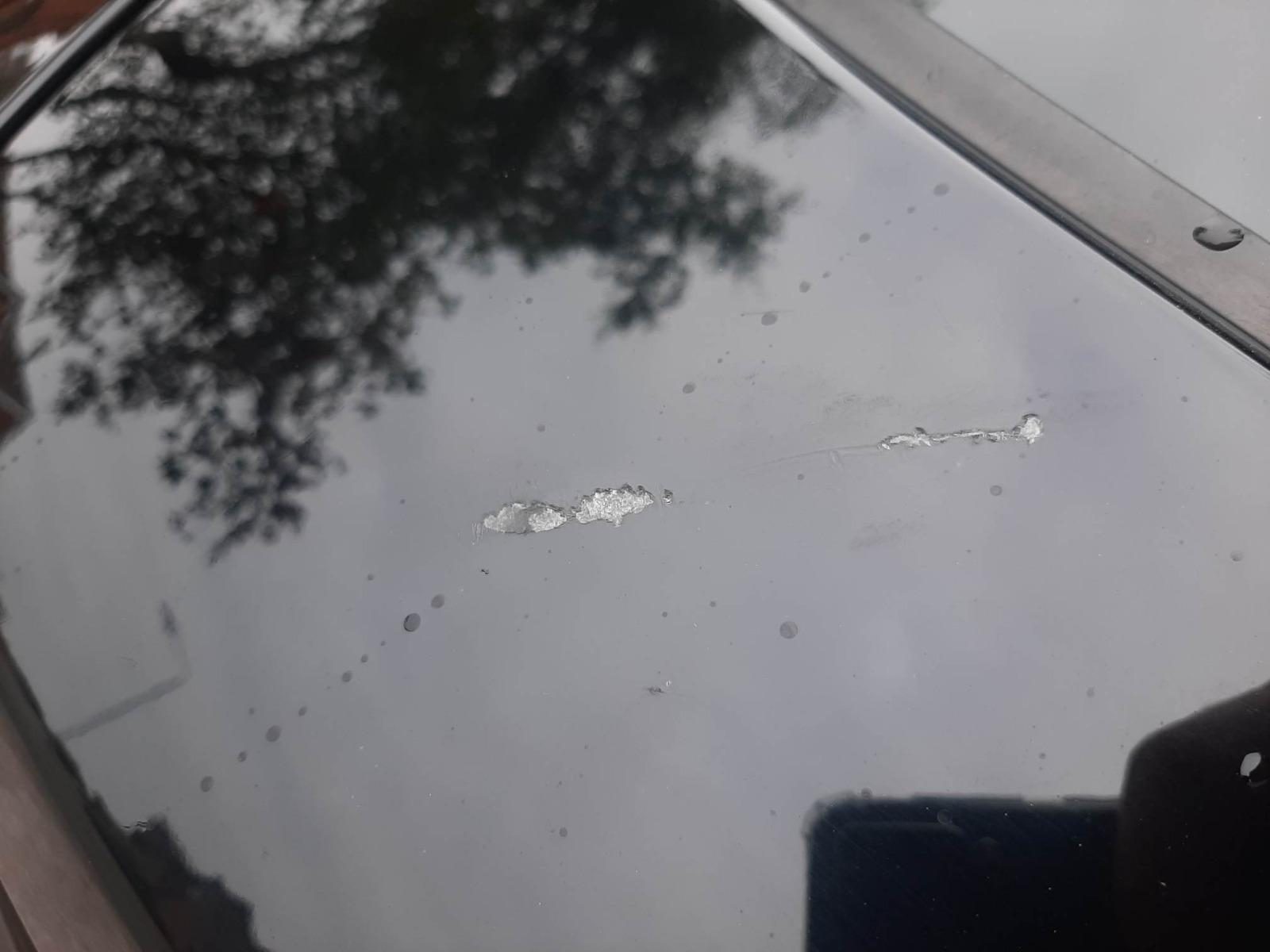
The paint is the deciding factor. Modern automotive paint is flexible enough to stretch with the metal underneath, so a surprising amount of deformation can happen without the finish cracking. Once you can see bare metal, primer or a spiderweb of cracks in the lacquer, PDR alone will not give you a finished repair.
| Suits paintless dent repair | Needs a painted repair |
|---|---|
| Round or oval dents with unbroken paint | Any dent where the paint is chipped, cracked or scraped through |
| Door dings from adjacent vehicles | Sharp creases with a knife edge in the metal |
| Shopping trolley and bollard knocks | Damage where the metal has been stretched or torn |
| Hail dimples across a bonnet or roof | Dents through a body line the panel cannot recover |
| Shallow dents on a bonnet, wing, door or boot lid | Damage on a double skinned or heavily braced section with no access behind |
| Panels being prepped before a conventional repair | Cracked plastic bumpers and bumper covers |
Two other limits are worth knowing. Dents very close to the edge of a panel are harder because the metal there is folded and stiffened for strength, so it resists moving. And a dent that has already been filled or repainted by someone else usually cannot be worked with PDR, because the filler will not move with the metal.
PDR also earns its place as a preparation step. On a more heavily damaged panel, a technician will often use dent rods to bring the metal back close to shape first, so that the filler and paint stage that follows is a skim rather than a rebuild. Less filler means a flatter, more durable finish.
How is a paintless dent repair carried out?
The technician assesses access, sets up a reflected light source, then works the metal back from the outside in with progressively finer tools until the panel reads flat. The whole job is done by feel and by reading a reflection, which is why it takes years to learn properly.
The typical sequence looks like this:
- Assess the damage. Check whether the paint is intact, how sharp the dent is, whether the metal has stretched and what lies behind the panel.
- Gain access. Remove trim, a door card, a light cluster or an inner liner as needed, or plan a glue pull if the back of the panel is sealed.
- Set up the light. A striped or line board reflected in the panel exaggerates every high and low point, so the technician can see movement of a fraction of a millimetre.
- Work the perimeter inwards. Dents have tension around the edge that has to be released first, otherwise pushing the centre simply creates a high spot.
- Push in small increments. Dozens or hundreds of small controlled pushes, checking the reflection constantly, rather than a handful of heavy ones.
- Knock down high spots. A blending hammer and knockdown tool tap any raised metal back level.
- Refit and check. Trim goes back, and the panel is checked again in different light before the car is handed over.
Some dents need several passes to fully release. On a stubborn one, no honest technician will guarantee a hundred per cent result before starting, because the behaviour of the metal is only fully known once work begins. What a good technician will do is tell you up front what result to expect and what the fallback is.
Does paintless dent repair actually work?
Yes, and for superficial dents with unbroken paint it is the best method available. Most minor dents can be taken out to the point where you cannot find the damage without knowing exactly where to look, and many come out completely.
Two things determine the result more than anything else: the condition of the paint and the sharpness of the dent. A broad, shallow dent the size of a saucer will usually come out fully. A short, sharp crease with a defined edge has stretched metal in it, and stretched metal has to go somewhere. In that case a technician can dramatically improve the appearance but may leave a faint trace visible in strong reflected light.
Access matters too. A dent in the middle of a door skin with the door card removed is straightforward. The same dent behind a reinforcement bar, a sound deadening pad or a sealed cavity is a different job, and may need glue pulling instead of rod work, which is slightly less precise.
Can PDR fix small dents and dings?
Small dents are exactly what PDR is best at, provided the area behind the dent can be reached. A ding of an inch or two across with intact paint is close to an ideal candidate, and often takes under an hour.
The exceptions are the same as ever. If the paint is broken, if the ding sits on a sharp swage line, or if it is right on the folded edge of a panel where there is no room to get a tool in, the technician will suggest an alternative. On a small area of broken paint, that alternative is usually a SMART repair, which repairs and repaints a localised patch rather than the whole panel.
Should you fix dents in your car?
Fix them, and fix them sooner rather than later. A dent is a small area of damage, typically no larger than the palm of your hand, and while it rarely affects how the car drives, it does three things you would rather avoid.
It looks bad. A single door ding is the first thing the eye lands on when someone walks up to an otherwise clean car.
It can lead to corrosion. A dent with unbroken paint is stable, but the same impact that dented the panel may have cracked the paint on the reverse side or disturbed the seam sealer. Once moisture reaches bare steel, you have a rust problem rather than a dent problem, and rust repair costs considerably more.
It costs you money on resale or return. Trade valuations and lease end inspections both work off condition, and cosmetic damage comes straight off the figure.
Why should I consider paintless dent repair over a conventional repair?
PDR is quicker, cheaper and less invasive than a filled and painted repair, and it preserves the factory paint. The specific advantages break down as follows.
You usually avoid an insurance claim
A minor PDR job typically costs less than a comprehensive policy excess. Paying directly keeps your no claims discount intact and avoids the premium increase that follows a claim, which over a few renewals can easily outweigh the repair itself.
Dents of many sizes can be tackled
Size is far less important than paint condition. A large, shallow dent with intact paint is often an easier job than a small, sharp one. If the paint has been broken, you are into paintwork repair territory regardless of dent size.
No colour matching required
No paint is used, so there is nothing to match and nothing to blend. On repairs that do need paint, a proper body shop mixes to the manufacturer's paint code and blends into adjacent panels, but the safest match is always the paint that is already there.
It saves time as well as money
There is no filler to cure, no primer to flash off, no paint to bake and no lacquer to harden. Most PDR jobs are done in a few hours and the car can be driven and washed straight away, rather than sitting in a body shop for two or three days.
It protects resale and lease return value
Original paint is a selling point. A car with all its factory finish intact and no dents photographs better, inspects better and holds its money better than one with a resprayed panel.
Should I fix dents in my car before selling it?
Yes, almost always. The used market is competitive and buyers make their decision on first impressions long before they look at the service history. Visible dents suggest a car that has been treated carelessly, and a buyer will assume the mechanical care has been just as casual.
The economics usually work in your favour too. Dents give a buyer an obvious lever to negotiate with, and the discount they ask for is generally larger than what the repair would have cost you. The same logic applies at the end of a lease or PCP agreement, where the finance company inspects against a published fair wear and tear standard and charges for anything beyond it. Sorting the damage out before the inspection is nearly always cheaper than the recharge.
How much does paintless dent repair cost?
Considerably less than a conventional filled and painted repair, because there are no paint materials and far less labour. Cost is driven by the number of dents, their size and sharpness, their position on the panel and how much trim has to come off to reach them.
The variables that push a price up:
- Position. Dents near a panel edge, on a body line or behind bracing take longer.
- Access. If a door card, headlining or bumper has to be removed, that time is added to the job.
- Quantity. Multiple dents on one panel, as with hail damage, are priced as a set rather than individually.
- Sharpness. A sharp crease takes many more passes than a soft dent of the same size.
- Panel material. Aluminium panels take longer than steel.
The only honest way to get a figure is to have the damage looked at, or to send a few clear photographs taken in daylight from a low angle so the dent shows in the reflection. Signature gives free quotes and answers them within 24 hours.
Is mobile paintless dent repair as good as workshop work?
For PDR specifically, mobile work is every bit as good, because the process needs no spray booth, no paint drying and no controlled dust free environment. All the technician needs is access to the panel, a power supply for lighting and enough space to work around the car.
That makes it well suited to being carried out on a driveway, in a work car park or at a dealership. Signature covers Greater Manchester, Lancashire, Cheshire, Merseyside and West Yorkshire with a mobile dent repair service, and also works from the body shop at Radcliffe when a job needs the extra facilities.
Where mobile work has limits is on anything requiring paint. Rain, cold, wind and airborne dust all affect how paint lays down and cures, so painted repairs are booked around the weather or brought into the unit. A dent with broken paint therefore may become a workshop job, which is another reason it pays to get an assessment before assuming which route a repair will take. If you want a price, send photographs through the quick quote form or ring 0161 667 0919.
Need this doing properly?
Signature repairs alloy wheels and bodywork across Greater Manchester and the North West, mobile at your home or workplace. Free quotes answered within 24 hours.